
ASTHMA
Asthma is a chronic disease of the airways (breathing tubes) in the lungs. This means that you have
asthma even when you feel fine and that your asthma can flare up at any time.
Asthma affects the airways in these ways:
- Walls of the airways are more swollen. This is called inflammation.
- The airways are also extra sensitive, meaning that they react to certain things that you breathe
in. Muscles around the airways can easily tighten and squeeze down. - The airways make more thick and sticky mucus
All of these changes make the airways narrow, so it is hard for air to go in and out of your lungs. This can make it hard to breathe and cause other asthma symptoms like coughing and wheezing.
There is no cure for asthma, but there is a lot you can do to control your asthma so that you can live a normal, active life and sleep through the night without asthma problems.
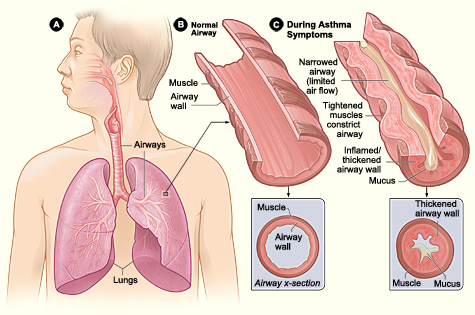
This picture shows where the lungs are in the body. It also shows the differences between an airway not affected by asthma and an airway affected by asthma.
What causes asthma?
- The exact cause of asthma is not known. Genetics (what runs in your family) and environment
(what is in the air you breathe) are both important. - Many different things (called triggers) can make asthma worse:
- Allergens – pollen, pets, cockroach, mold, dust mites
- Irritants – smoke, perfumes, cleaning products
- Colds, weather changes, exercise, emotions
- It is important to learn about your asthma triggers, since they can be different for different
people. Knowing your triggers and how to avoid them can help keep you healthy
What are asthma symptoms?
Symptoms are what you feel in your body. Everybody is different, but here are some common
asthma symptoms:
- Cough
- Shortness of breath
- Wheezing
- Chest tightness or chest pain
You might have just some or all of these symptoms at times. They might not bother you much or
they might feel very bad if your asthma is flaring up.
What can you do to control your asthma and prevent symptoms?
- Follow your Asthma Action Plan, even when you are feeling well.
- Try to stay away from things that make your asthma worse.
- Talk to your doctor if you have more symptoms than usual or need to use your quick-relief
medicine more often.
What should you do if you start to have problems with your asthma?
- Look at your Asthma Action Plan to know what medicine to take and how much.
- Take your quick-relief medicine as soon as you have symptoms. This can keep your symptoms
from getting worse. - Call your doctor or get medical care if the medicine does not help.
Adapted from the National Heart Lung and Blood Institute’s Diseases and Conditions Index:
http://www.nhlbi.nih.gov/health/dci/Diseases/Asthma/Asthma_WhatIs.html
Controlling Things That Make Asthma Worse
Smoke
- Do not smoke. Attend classes to help stop smoking.
- Do not allow smoking in the home or car. Remaining smoke smell can trigger asthma.
- Stay away from people who are smoking.
- If you smoke, smoke outside.
Dust
- Vacuum weekly with a vacuum with a high efficiency filter or a central vacuum. Try to make sure people with asthma are not home during vacuuming.
- Remove carpet if possible. Wet carpet before removing and then dry floor completely.
- Damp mop floors weekly.
- Wash bedding and stuffed toys in hot water every 1-2 weeks. Freeze stuffed toys that aren't washable for 24 hours.
- Cover mattresses and pillows in dust-mite proof zippered covers.
- Reduce clutter and remove stuffed animals, especially around the bed.
- Replace heating system filers regularly.
Pests
- Do not leave food or garbage out. Store food in airtight containers.
- Try using traps and poison baits, such as boric acid for cockroaches. Instead of sprays/bombs, use baits placed away from children, such as behind refrigerator.
- Vacuum up cockroach bodies and fill holes in with caulking or copper wool.
- Fix leaky plumbing, roof, and other sources of water.
Mold
- Use exhaust fans or open windows for cross ventilation when showering or cooking.
- Clean mold off hard surfaces with detergent in hot water and scrub with stiff brush or cleaning pad, then rinse clean with water. Absorbent materials with mold may need to be replaced.
- Make sure people with asthma are not in the room when cleaning.
- Fix leaky plumbing or other sources of water or moisture.
Animals
- Consider not having pets. Avoid pets with fur or feathers.
- Keep pets out of the bedroom of the person with asthma.
- Wash your hands and the hands of the person with asthma after petting animals.
Odors/Sprays
- Avoid using strongly scented products, such as home deodorizers and incense, and perfumed laundry products and personal care products.
- Do not use oven/stove for heating.
- When cleaning, keep person with asthma away and don't use strong smelling cleaning products.
- Avoid aerosol products.
- Avoid strong or extra strength cleaning products.
- Avoid ammonia, bleach, and disinfectants.
Pollen and Outdoor Molds
- Try to stay indoors when pollen and mold counts are high.
- Keep windows closed during pollen season.
- Avoid using fans; use air conditioners.
Colds/Flu
- Keep your body healthy with enough exercise and sleep.
- Avoid close contact with people who have colds.
- Wash your hands frequently and avoid touching your hands to your face.
- Get an annual flu shot.
Weather and Air Pollution
- If cold air is a problem, try breathing through your nose rather than your mouth and covering up with a scarf.
- Check for Spare the Air days and nights and avoid strenuous exercise at those times.
- On very bad pollution days, stay indoors with windows closed.
Exercise
- Warm up before exercise.
- Plan alternate indoor activities on high pollen or pollution days.
- If directed by physician, take medication before exercise.
Using a Metered Dose Inhaler With a Spacer
You will use a spacer with your inhaler. Following these directions will help put more of your medicine in your lungs. This will open up your air passages and help you breathe easier and feel better.
To use your inhaler with a spacer
- If your inhaler is new or has not been used for 2 weeks: Shake well. Push down on the inhaler 2-4 times into the air. Shake each time you push down on the inhaler.
- Shake the inhaler well before use (3-4 shakes and hard for about 5 seconds). You should be standing while using your inhaler.
- Remove the cap from your inhaler, and from your spacer, if it has one
- Put the inhaler into the spacer
- Breathe out, away from the spacer
- Bring the spacer to your mouth, put the mouthpiece between your teeth and close your lips around it
- Press the top of your inhaler once
- Breathe in very slowly until you have taken a full breath. If you hear a whistle sound, you are breathing in too fast. Slowly breathe in.
- Hold your breath for about ten seconds, then breathe out. Repeat the above steps for each puff ordered by your doctor. Wait about 1 minute in between puffs.
- Replace the cap on your inhaler when finished.
Weekly Inhaler Cleaning Instructions
- Take the canister out of the sleeve and take the cap off the mouthpiece
- Wash the plastic sleeve through the top and bottom with warm running water for 30 to 60 seconds
- Shake off excess water from the plastic sleeve and allow to dry completely
- Look into the mouthpiece to make sure any medicine build-up has been completely washed away. If there is any build-up, repeat cleaning
- When dry, place the metal medication canister into the plastic sleeve and store with cap in place
Spacer Cleaning Instructions
- Take the spacer apart.
- Gently move the parts back and forth in warm water using a mild soap. Never use high-pressure, dish washer or boiling hot water, rubbing alcohol or disinfectant.
- Rinse the parts well in clean water.
- Do not dry inside of the spacer with a towel as it will cause static. Instead, let the parts air dry (for example, leave them out overnight).
- Put the spacer back together.